
This is an updated version of a 2024 article titled "BC’s Latest Child Care Funding Model Lacks a Genuine Wage Grid"
In 2018, BC became the first province outside of Quebec to commit to universal child care. [1]
Towards this goal, BC created an “Early Care and Learning Recruitment and Retention Strategy” that acknowledged educators’ poor wages and introduced a $1/hour “wage enhancement” in response. [2] BC has since increased the wage enhancement to $4-$6/hour. [3]
These one-off wage enhancements have been somewhat helpful, but they’re problematic over the long-term. That’s why in 2020 the Early Childhood Educators of BC and the Coalition of Child Care Advocates of BC recommended a competitive, publicly-funded provincial “wage grid” as the critical next step in solving BC’s shortage of educators. [4]
In response, in 2021 BC committed to develop a child care wage grid. [5]
Misleading claims
In the fall of 2023, BC began a test of a new way of funding child care with a small number of programs. This test continues, with the province claiming it “includes a wage grid” for participating programs and moves BC closer to its commitment of a wage grid, province-wide. [6]
But, contrary to government claims, BC’s latest funding model does not include a wage grid. In fact, it directly undermines many of the key goals of a wage grid.
Here’s how BC’s latest funding model pays for educator wages:
Table 1 – Wage funding in BC’s 2024/2025 Operating Funding Model (OFM) [7]
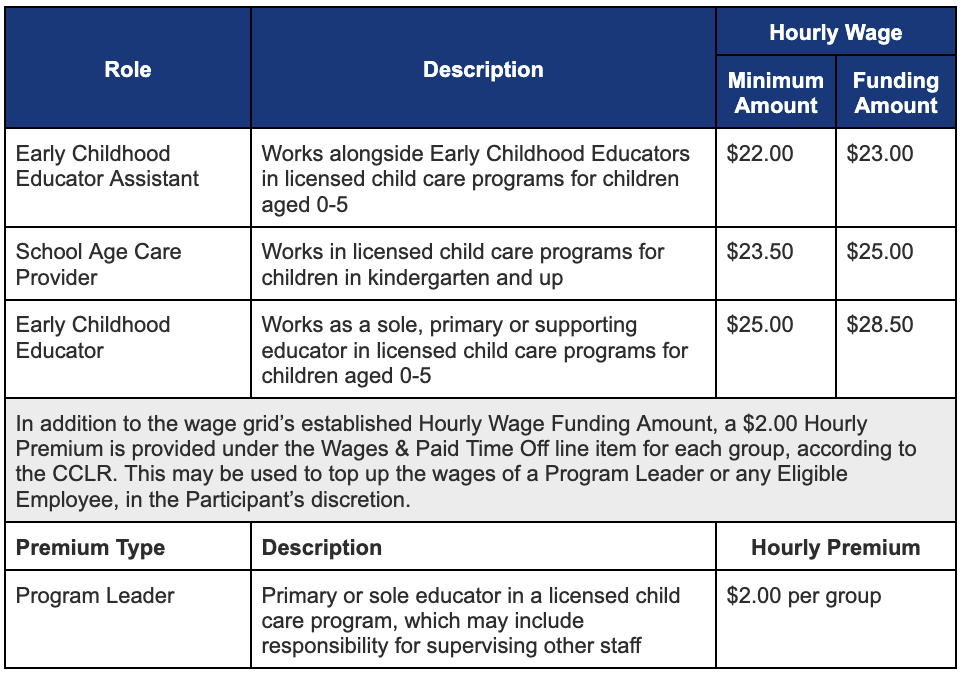
Providing more detail about how this wage funding system works, the government says:
It “establishes a minimum wage that must be paid for each specified role providing direct care to children, along with the corresponding funding level that the Participant will receive. The funding level exceeds the minimum hourly wage, providing Participants with flexibility to set the wages of their Eligible Employees in a manner that addresses their specific staffing needs, as long as Eligible Employees receive at least the minimum wage levels. For clarity, the Participant may pay Eligible Employees an hourly wage that exceeds the funding levels in the wage grid, provided that neither the Province, nor any Parents (whether through a Parent Fee, Optional Fee, or other additional fees) will be required to provide additional funding to the Participant to cover those higher wages.” [8]
The problem:
1. This is not a wage grid
2. This directly undermines key goals of a wage grid
Furthermore:
3. This approach does not consistently fund competitive compensation
4. This approach does not consistently fund adequate staffing level
1. It's not a wage grid
Contrary to the government’s claims, the wage funding structure used in BC’s latest funding model is not a wage grid.
A real wage grid, as recommended by the Coalition of Child Care Advocates of BC and Early Childhood Educators of BC, sets out how educators’ compensation increases in guaranteed increments corresponding to qualifications held, years of experience, and job role/responsibilities.
The following is an example of what a real wage grid looks like.
Table 2: April 2024 wage grid for ECEs employed by BC’s health authorities (not including ECE Wage Enhancement) [9]
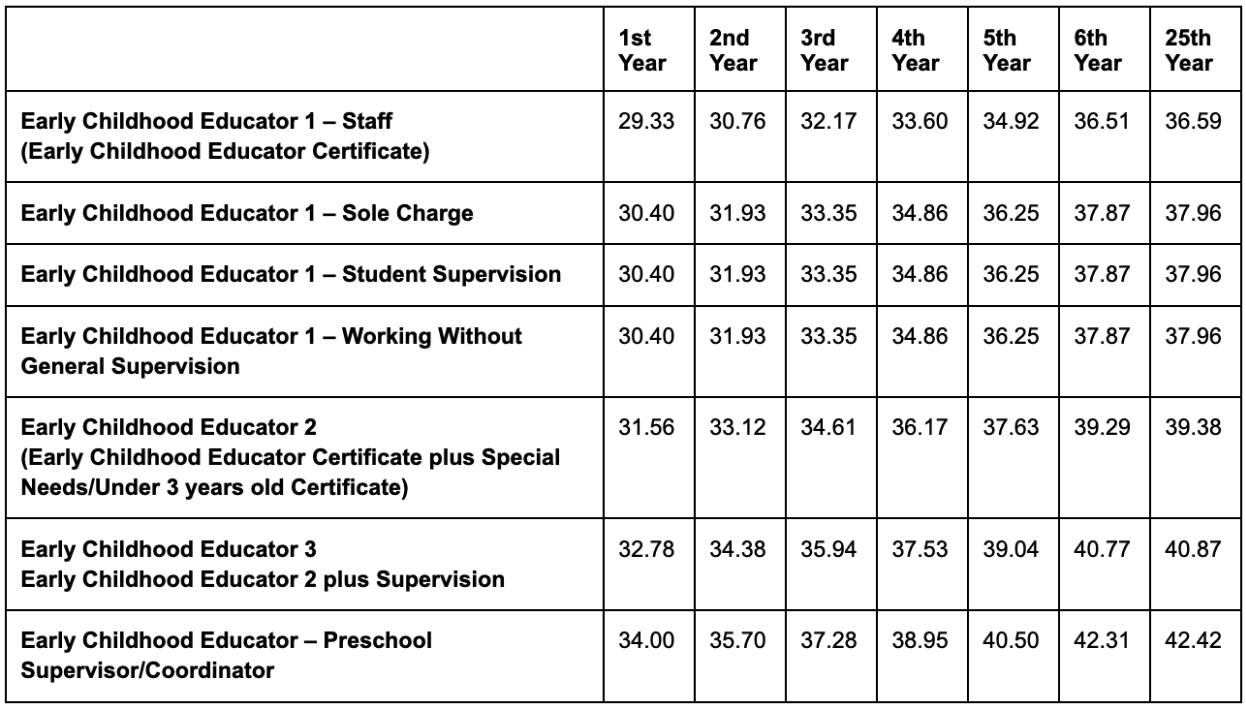
In the example public sector wage grid above:
-
Wages are firmly set
By contrast, BC’s latest funding model has every program using the allocated “funding amount” to set their own customized wages as best they can above a “wage floor.” Each program’s achievable wages depend on a complex and opaque “funding buffer” mechanism. [10]
-
These set wages are guaranteed to increase with qualifications, role and years of experience, for every educator.
By contrast, in BC’s latest funding model (refer back to Table 1), the provincial “funding amount”:
-
Does not increase in response to any additional educator qualifications beyond a 1-year certificate. For example, Infant/Toddler and Special Needs educators with a two-year diploma are funded at the same rate as those with a 1-year basic certificate.
-
Does not increase with years of experience.
-
Is not guaranteed for every educator who holds the associated qualification. Instead, the province only provides funding to achieve the minimum aggregate qualification levels under BC’s Child Care Licensing Regulation. [11] For example, if a particular child care program only requires 1 ECE (per minimal licensing standards), but employs two, only one of them gets funded at the higher rate in BC’s latest funding model, with the other educator being funded at the much lower ECE Assistant rate. This is not equitable and advances a “lowest common denominator” of individual program quality because it (a) creates an incentive for undercompensated educators to leave programs or the sector altogether, (b) leads educators to forego additional education because they see no guaranteed reward, and/or (c) incentivizes administrators to only hire to the minimum level of qualifications under licensing regulations.
- There are complex and opaque ways around the above constraints, in the way of a “funding buffer” mechanism and the potential for special permissions, but the amount of achievable extra funding will vary from program to program, undermining consistency and forcing trade-offs. [12]
-
Does not increase in response to any additional educator qualifications beyond a 1-year certificate. For example, Infant/Toddler and Special Needs educators with a two-year diploma are funded at the same rate as those with a 1-year basic certificate.
In summary, the BC government is being misleading when it says that its latest funding model includes a wage grid. It does not.
2. It undermines key goals of a wage grid
Child care wage grids have been recommended here in BC and nationally because:
-
They achieve equity, consistency, predictability, and transparency in wage rates.
-
All educators with the same qualifications, role and years of experience are paid the same (equity and consistency), potentially including e.g. regional variations linked to cost-of-living or other recruitment variables.
-
All educators know what they’ll be paid if they stay in the sector, choose to upgrade their qualifications or take a new role (predictable and transparent paths to career progression and higher compensation).
-
All educators with the same qualifications, role and years of experience are paid the same (equity and consistency), potentially including e.g. regional variations linked to cost-of-living or other recruitment variables.
-
By providing guaranteed, set increases in pay they incentivize increasing qualifications and retention, and therefore a more qualified and experienced workforce and higher program quality.
BC’s latest funding model directly undermines the above goals by having programs set their own customized wages, and by using a system where each program’s total wage funding varies significantly according to an opaque funding buffer mechanism and other factors.
3. It does not consistently fund competitive compensation
BC’s latest funding model is inherently confusing because the published “funding amount” doesn’t directly translate into what programs will be able to actually pay their staff. Instead, an opaque funding buffer mechanism comes into play, in combination with potential (not guaranteed) permissions to move more funding into one’s HR envelope. [13]
The end result is inconsistency in achievable compensation.
Some programs with high funding buffers or special permissions will be able to provide competitive compensation, while others won’t.
4. It does not consistently fund adequate staffing levels
Again, BC’s latest funding model relies on an opaque funding buffer mechanism to make up for inadequacies in the model’s published wage funding amounts, funded sick days, funded pro-D time, etc. [14]
It is expected that each program will use its funding buffer in a customized way to supplement wages, benefits and all other aspects of compensation, as well as achievable staffing levels. But the amount of funding buffer can vary significantly by program (in response to hours of operation and attendance patterns), and if this funding buffer is used for one purpose (e.g. boosting wages), it will be less available for other purposes (e.g. sick time, adequate staffing levels, etc.).
The end result is inconsistency in achievable staffing levels.
In fact, the end result of the model, overall, is inconsistency in achieving everything. Each program’s achievable wage rates, overall compensation, and staffing levels (including aggregate qualifications) will be different and subject to complex trade-offs.
Prioritizing “flexibility” of operators over the goals of a wage grid?
In describing its latest funding model, BC cites an objective to “provid[e] Participants with flexibility to set the wages of their Eligible Employees in a manner that addresses their specific staffing needs…” [15]
Those “staffing needs” are not explained further, but the upshot is that – whatever these needs are – by way of this funding model BC has decided they are more important than delivering on its 2022 promise of a child care wage grid.
In other words, BC seems to have deemed these undefined “staffing needs” more important than providing all child care educators with equitable, consistent, transparent and predictable compensation – and more important than the associated incentives towards higher workforce qualifications and program quality.
Conclusion: BC needs to deliver a real wage grid, with ECE wages of at least $30-$40/hour
A genuine wage grid is a key building block of a high-quality, universal child care system. [16]
Reflecting this, seven other provinces and territories now have some form of sector-wide ECE wage grid, while BC – still – does not. [17]
BC needs to finally deliver on its commitment to a real province-wide wage grid, and must ensure ECE wage rates in the grid are at least $30-$40/hour in order to be competitive and equitable. [18]
[1] As outlined in the 2018 ChildCareBC Plan, and more recently, as reiterated in the BC Budget 2024 Service Plan for the Ministry of Education and Child Care (2024/25 – 2026/27) (pp. 4, 17).
[2] Early Care and Learning Recruitment and Retention Strategy, Government of British Columbia (2018).
[3] Early Childhood Educator Wage Enhancement Funding Guidelines (2025/2026), Government of British Columbia (2025).
[4] Lynell Anderson, Michelle Sing, Rebecca Haber, “Next Step: A Competitive, Publicly Funded Provincial Wage Grid is the Solution to BC’s ECE Shortage,” Coalition of Child Care Advocates of BC and Early Childhood Educators of BC, 2020.
[5] First, in the Canada-British Columbia Canada-Wide Early Learning and Child Care Agreement – 2021 to 2026, BC commited to "developing a wage grid for ECEs and committing to its implementation." This commitment was reiterated in a subsequent Mandate letter to the Honourable Grace Lore, Minister of State for Child Care, Office of the Premier of British Columbia (Dec 2022).
[6] See pg. 13 of $10 a Day ChildCareBC Centres Operating Funding Model Test: Phase 2 – 2024 Intake. Policy and Procedures Manual, Government of British Columbia (Dec 2024).
[7] Ibid.
[8] Ibid. (pg. 8)
[9] ECEs covered by the Health Sciences Professionals collective agreement; The ECE classifications and associated grid levels listed in the Table can be found here. Please note the classification system for child care workers under this agreement has since changed/is being changed (including retroactive changes to Apr 2024 rates). The new classification system and updated wage grid can be found here; the classifications are no longer intuitive just from their name/code. These wages do not include the $4/hour ECE Wage Enhancement available to ECEs employed by public sector entities.
[10] See pp. 42-46 of Eric Swanson, Child Care When Families Need It: 30 Recommendations for Advancing Non-standard Hours and Flexibly Scheduled $10aDay Child Care in BC, Coalition of Child Care Advocates of BC, 2025.
[11] Supra note 6. Refer to pg. 14: “Funding is provided to the Instructional Human Resources Funding Envelope based on the required role(s) [as specified by the minimum aggregate qualification levels in the Child Care Licensing Regulation] for each child care centre, not the certificate level held by the Eligible Employee. For example, an ECE working in before/after-school care would be funded as a School Age Care Provider, and not as an ECE, as the Responsible Adult.”
[12] Supra note 10.
[13] Supra note 10.
[14] Supra note 10.
[15] Supra note 6 (p.14).
[16] Supra note 4. See also Eric Swanson, “A Two-Pillar Model: Set Fees for Families and Set Compensation for Staff – Technical Recommendations on Child Care Operating Funding for Policy Makers and the Sector”, CCCABC and ECEBC, 2024. And “Wages, benefits and pensions: Policy recommendations developed by the National Early Learning and Child Care Workforce Policy Table”, Child Care Now (2024).
[17] E.g. as summarized here (accessed June 16, 2025). Jurisdictions with a wage grid at time of writing include Northwest Territories, Nunavut, Quebec, PEI, Nova Scotia, New Brunswick, and Newfoundland and Labrador.
[18] Eric Swanson, “Early Childhood Educator Compensation in BC: Spring 2024 Update,” CCCABC and ECEBC, 2024. A more comprehensive analysis of “competitive” wages is forthcoming.

Do you like this page? Share on





