
Learn more about the kind of $10aDay child care system BC needs, and our recommendations about how to build it.
Featured
 Let's Get it Done: $10aDay Child Care 2026 BC Election Brief
September 2026
This election brief summarizes why child care is a critical issue this election, the current problems with BC's child care system, the solutions we're asking all parties to commit to, and how child care investments largely or more than pay for themselves.
 Defending Universal Child Care: Why More Income-Testing is the Wrong Path for BC
June 2026
This policy brief responds to ongoing discussions about introducing additional income-testing into BC's child care system. In short, ECEBC we say "No". For those who argue that “families who earn more should pay more”, we say “they do” — thanks to our progressive tax system.
 From Pause to Progress: The Future of Universal Child Care in BC
June 2026
Child Care in BC is at a crossroads. This two-pager provides 10 key solutions to ensure the province does not veer off down the wrong track.
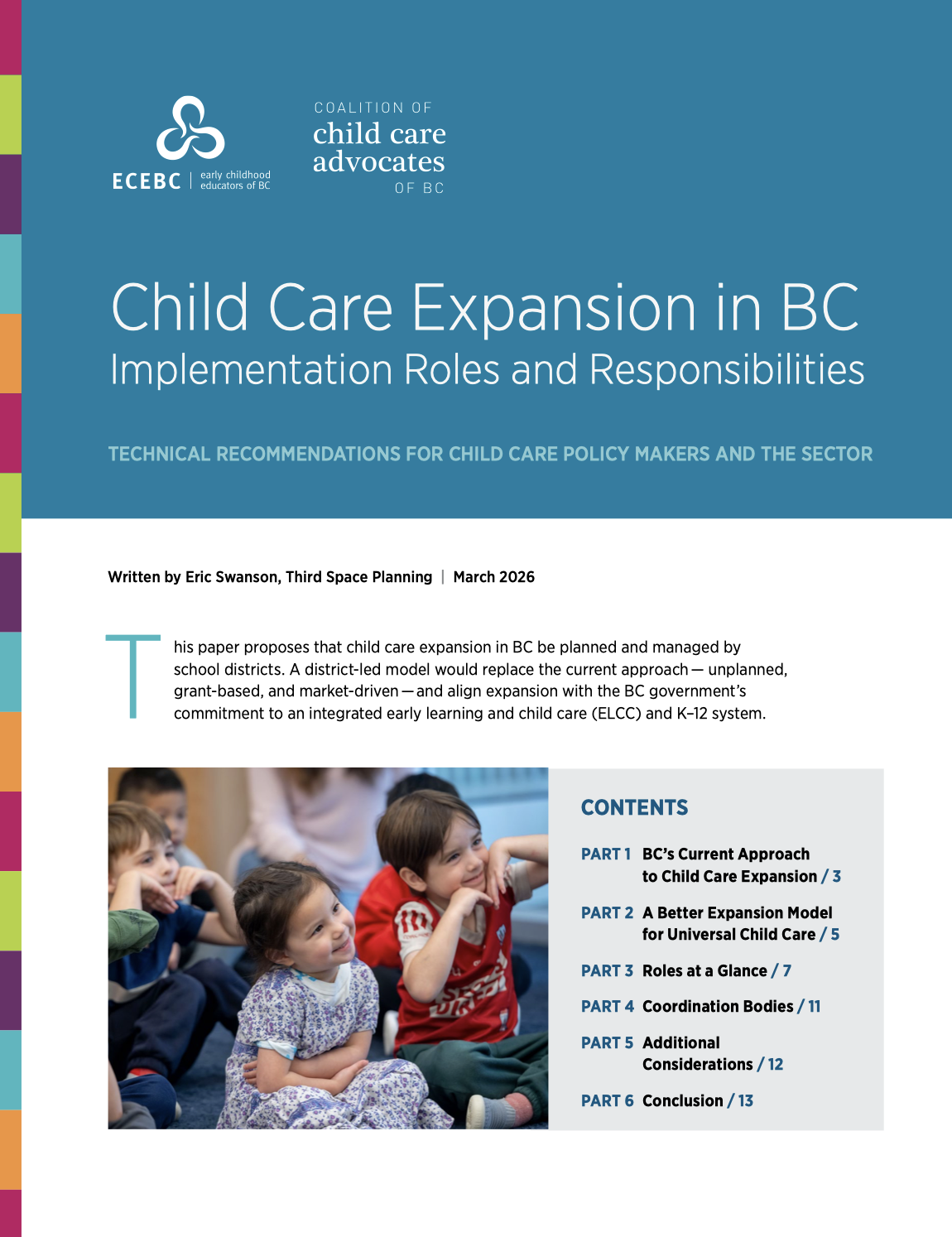 Child Care Expansion in BC: Implementation Roles and Responsibilities. Technical recommendations for child care policy makers and the sector
April 2026
This paper proposes that child care expansion in BC be planned and managed by school districts. A district-led model would replace the current approach — unplanned, grant-based, and market-driven — and align with BC’s commitment to an integrated early learning and child care and K–12 system.
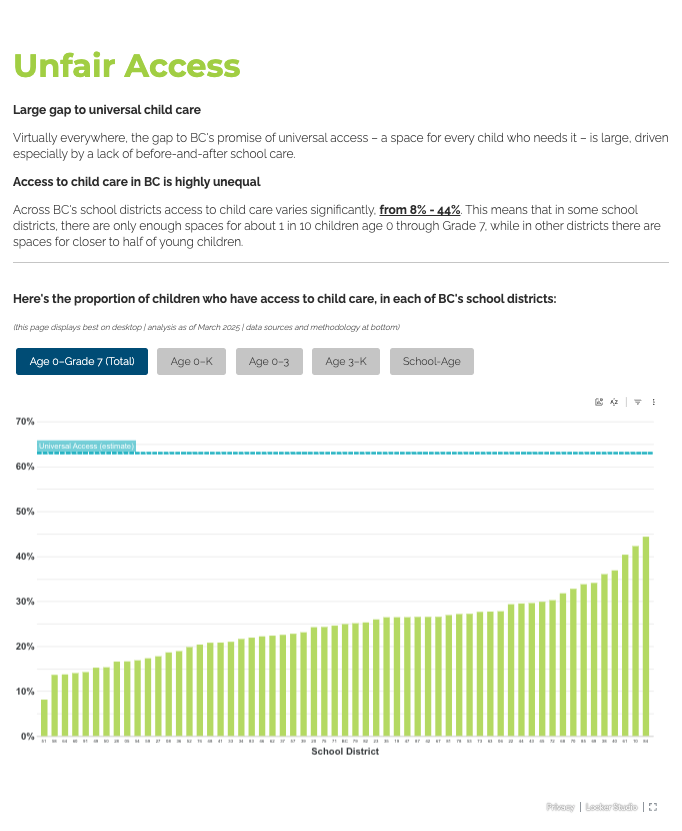 Unfair Access
June 2025
This interactive online tool shows the gap to universal child care in each of BC's school districts, and how your access to child care varies significantly depending on where you live.
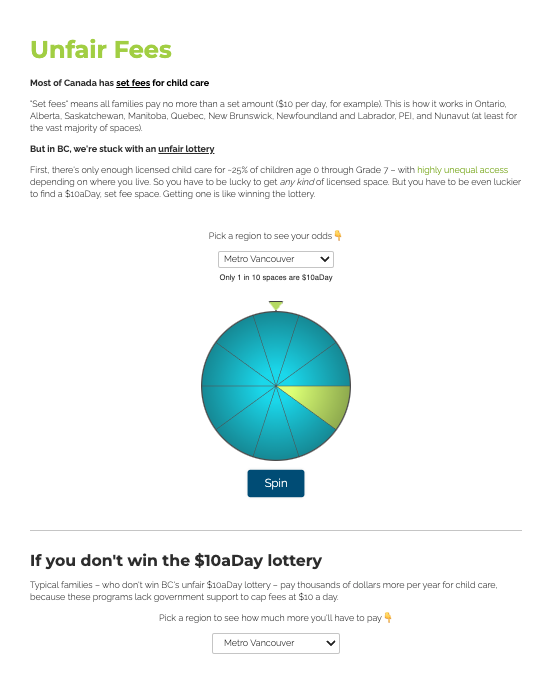 Unfair Fees
June 2025
This interactive online tool shows your odds of winning "the $10aDay lottery" in BC's different regions, and the amount of unfair extra child care fees you'll typically have to pay if you're not lucky.
 The Economic Benefits of Expanded Child Care Services in British Columbia
June 2025
This analysis by Dr. Jim Stanford of the Centre for Future Work quantifies the estimated economic, labour market, and fiscal benefits for British Columbia of combined provincial and federal investments in child care since 2019.
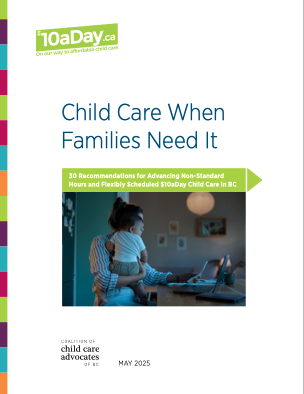 Child Care When Families Need It: 30 Recommendations for Advancing Non-standard Hours and Flexibly Scheduled $10aDay Child Care in BC
May 2025
This publication explores why – and how – to ensure all families can access child care when they need it. It focuses on making BC's 2024 "Test Operating Funding Model/OFM" work better for all types of child care, including both standard and non-standard hours and scheduling (summary | full report).
 A Two-Pillar Model: Set Fees for Families and Set Compensation for Staff. Technical recommendations on child care operating funding for policy makers and the sector
Dec 2024 (updated June 2025)
This publication makes the case for rapidly transitioning all licensed child care programs in BC to a "two-pillar" $10aDay operating funding model that sets consistent fees for families and consistent compensation for educators and other staff.
 Bringing BC’s for-profit child care operators into a $10aDay model: Technical recommendations for child care policy makers and the sector
Dec 2024
This publication lays out the particular accountability issues associated with for-profit child care, and offers ways current BC policy could evolve to address them en route to a unified $10aDay child care funding model.
 Early Childhood Educator Compensation in BC: Spring 2024 Update
April 2024
This progress report updates our 2023 analysis showing that wages in BC's promised ECE wage grid need to be at least $30-$40/hour to be competitive, equitable and effective – incorporating new information from across Canada and a more-detailed benchmarking methodology.
 ROADMAP For $10aDay Child Care in BC
Spring 2022
Organized into eight key themes, this system-building roadmap is the latest version of our comprehensive $10aDay Plan.
(summary | full report)
Additional Resources
 Early Childhood Educator Wages in BC: Recommendations for a Wage Grid of At Least $30-$40/hour
July 2023
This analysis shows that wages in BC's promised ECE wage grid need to be at least $30-$40/hour for it to be competitive, equitable and effective.
(policy note | 30-min. video presentation)
 Child Care Facility Design Standards: Recommendations
May 2023
BC's forthcoming child care facility design standards have the potential to ensure all children and educators can play, learn and work in high-quality physical environments, but only if BC's child care expansion is adequately funded and provincially planned.
 Child Care and the Environment: Intersections and Opportunities
April 2022
This policy note provides ten recommendations to the BC government to strengthen, hasten, and better integrate its ChildCareBC and CleanBC plans.
 City of Vancouver 2020 Childcare Grant Analysis
October 2021
The City of Vancouver has historically provided grants to non-profit group childcare programs to enhance quality and help offset the cost to families. This study aimed to assess the impact of increasing funding from senior governments on the City of Vancouver's child care goals.
 Accelerating Implementation of the $10aDay Child Care Plan: Key to BC’s Economic Recovery
April 2021
This policy note calls for the BC government to add significant additional child care operating funding and a new capital budget to accelerate $10aDay implementation and help BC's economy recover from COVID.
 $10aday Child Care and ECEs in BC
September 2020
This joint statement from the Coalition of Child Care Advocates of BC and Early Childhood Educators of BC reaffirms the two organizations' shared commitment to working together to make the goal of a respected, well educated, and fairly compensated ECE profession a reality.
 Next Step: A Competitive, Publicly Funded Provincial Wage Grid is the Solution to BC’s ECE Shortage
June 2020
This comprehensive study finds that a provincial wage grid is the best option to achieve fair and competitive wages for Early Childhood Educators.
(summary | full report)
 The $10aDay Plan
February 2019
The 2022 Roadmap (above) can be considered the most recent version of our $10aDay Plan. While this historical version contains some outdated components, it includes additional context for those interested.
 Fee Subsidies Are Not the Answer
October 2017
This policy note explains why the best way to ensure child care is affordable for all families is for government to set capped fees (as in $10aDay programs) and directly fund programs, not provide fee subsidies.
 Socio-Economic Impact Analysis of the $10aDay Child Care Plan for British Columbia
January 2017
This in-depth study by economist Robert Fairholm concludes the $10aDay Plan will generate sufficient government revenues to pay for its full implementation, creating 69,100 jobs in the short-term.
(summary | full report)
 Solving BC's Affordability Crisis in Child Care - Financing the $10 a Day Plan
 July 2015
This study by economist and CCPA public interest researcher Iglika Ivanova shows that BC can easily afford to build a $10aDay child care system (either alone or with the federal government), providing substantial benefits for families, communities and the economy.
Archived documents:
-
Recommendations for Effective Expansion of Licensed Child Care Spaces in BC (December 2019)
- Policy Brief: Child Care Affordability in BC — What’s Working (and What’s Worrying) (September 2018)
- Comparing government’s ChildCareBC commitments with the community’s $10aDay Plan (March 2018)
- Full Implementation of the $10aDay Child Care Plan: Summary (January 2018)
- Key Areas of Alignment on Child Care: BC Government and BC Green Caucus (November 2017)
- BC Budget 2018: First Steps on $10aDay Child Care (October 2017)
- Making the Connections: Using Public Reporting to Track the Progress on Child Care Services in Canada (October 2007)
- Fact Sheet 1: What the $10aDay Plan means for Parents and Families
- Fact Sheet 2: Economic Rationale for Investing in the $10aDay Plan
- Fact Sheet 3: Demographics of Children and Families in BC
- Fact Sheet 4: How the $10aDay Plan will Reduce Family Poverty in BC
- Fact Sheet 5: How the $10aDay Plan is Good for BC Business
- Fact Sheet 6: How the $10aDay Plan Supports Early Childhood Educators
- Answers to Frequently Asked Questions

